The countdown is almost over. You've put in the hours, studied the material, and now the exam is just around the corner. This is the moment to shift from learning new information to consolidating what you know and building the confidence you need to succeed.
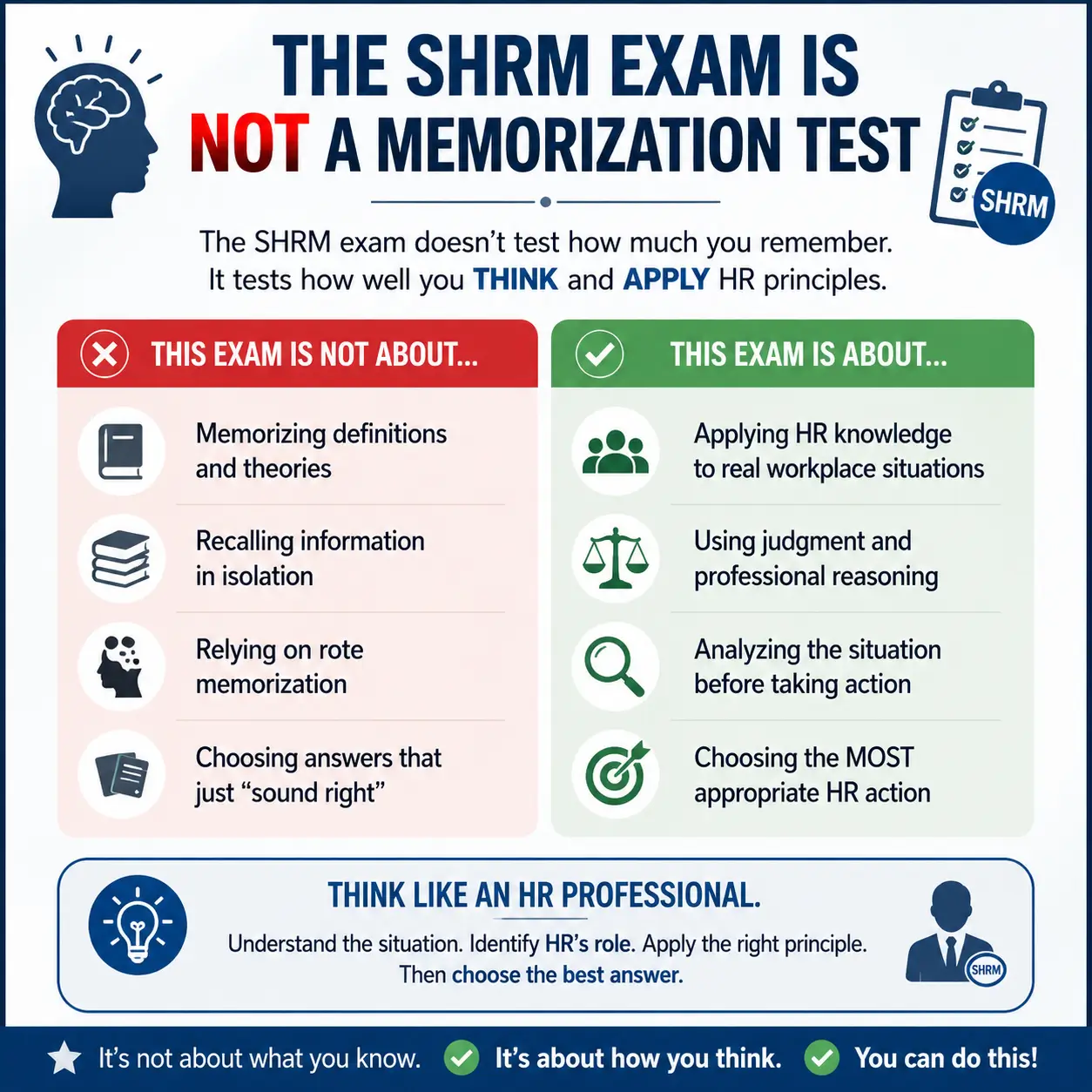
The SHRM-CP isn't just a test of memorization; it's a test of your judgment and your ability to apply HR principles in real-world scenarios. This guide will help you focus your efforts in these final hours and walk into the exam center (or log into your online proctoring) with a winning mindset.
Part 1: The Final 24-48 Hours - What to Do (and What NOT to Do)
This period is about refinement and relaxation, not cramming.
The "Don't" List:
DON'T try to learn something new. If you haven't learned the intricacies of a specific law by now, trying to cram it the night before will only cause confusion and anxiety.
DON'T pull an all-nighter. Your brain needs rest to retrieve information effectively. A tired mind is a slow and inaccurate mind.
DON'T doom-scroll through forums. Reading about other people's anxiety or wildly different study approaches will only heighten your own stress.
The "Do" List:
Review Your Mnemonics: Go over the memory aids you've created (e.g., for the HTPO model or the SHRM Code of Ethical Conduct).
Flashcard Flip: Quickly flip through your pre-made flashcards of key terms and formulas (like ROI, turnover rate). This is a recognition exercise, not a deep-dive.
Read the SHRM BASK (Body of Applied Skills and Knowledge): Skim through the BASK document. It’s the blueprint for the exam. Read the "Key Concepts" and "Proficiencies" for each functional area. This helps cement the high-level structure in your mind.
2. Master the SHRM Mindset (The "SHRM-isms"):
This is arguably more important than any single fact. The SHRM-CP tests how you think as an HR professional. In these final hours, internalize these core principles:
The "Business" Lens: Every HR decision must be linked to organizational goals, strategy, and the bottom line. Ask yourself: "How does this add value to the business?"
The "People" Lens: Solutions must be fair, equitable, and respectful of employees. This is the "heart" of HR.
The "Compliance" Lens: You must operate within the law. When in doubt, the most legally prudent and ethical answer is often the correct one.
Be a Strategic Partner, Not an Order-Taker: The correct answer will often involve you (the HR pro) proactively analyzing a situation, proposing a solution, and educating management, rather than just doing what you're told.
Collaboration is Key: The best answers usually involve partnering with leaders, consulting with stakeholders, and getting buy-in. Avoid answers where you work in a silo.
3. Prepare Your Logistics:
Photo ID: Have your government-issued ID ready. It must match the name on your registration.
Confirmation: Print out your SHRM exam appointment confirmation email.
Directions & Time: Know exactly where you're going, how long it takes to get there, and where you'll park. Plan to arrive at least 30 minutes early.
What to Wear: Dress in comfortable layers. Testing centers can be cold or warm. Pockets are often restricted, so choose clothing with minimal pockets or be prepared to empty them.
System Check: Run the system test on your computer again 24 hours before the exam.
Clear Your Space: Remove all books, notes, phones, smartwatches, and even a second monitor. Your desk must be completely bare.
Internet: Ensure you have a stable, wired internet connection if possible. Wifi can be unpredictable.
4. Take Care of Yourself:
Eat Well: Have a healthy, balanced meal the night before. Eat a light but protein-rich meal before the exam (e.g., eggs, yogurt, a protein bar) to avoid a sugar crash.
Hydrate: Drink water, but don't overdo it right before the exam to avoid unnecessary bathroom breaks.
Move Your Body: Go for a walk, do some light stretching. This helps to clear your head and reduce anxiety.
Disconnect: Give yourself a "digital curfew" an hour before bed. Read a book, listen to calming music, or meditate.
Part 2: The Day of the Exam - Your Game Plan
Use the restroom right before you check in.
Take a few deep, centering breaths.
2. During the Exam - Your Strategy:
You have 3 hours for 134 questions (90 scored + 40 unscored pretest questions). You won't know which are which, so you must give your best effort on every single one.
The 4-Question Types: Be ready for:
Knowledge-Based: Tests recall of a term, law, or theory. If you know it, great. If not, eliminate obvious wrong answers and make your best guess.
Situational Judgment (The "SHRM" Questions): These present a workplace scenario. Your job is to choose the BEST and LEAST effective action. This is where the "SHRM Mindset" is critical.
Formulas/Calculations: Know your basics (turnover, cost-per-hire, ROI, etc.). Write down any formulas you're worried about on the provided whiteboard/scrap paper as soon as the test starts.
Case Studies: A longer scenario with 3-5 multiple-choice questions based on the same information. Read the case study first, then tackle the questions one by one.
The SHRM Question-Answering Framework:
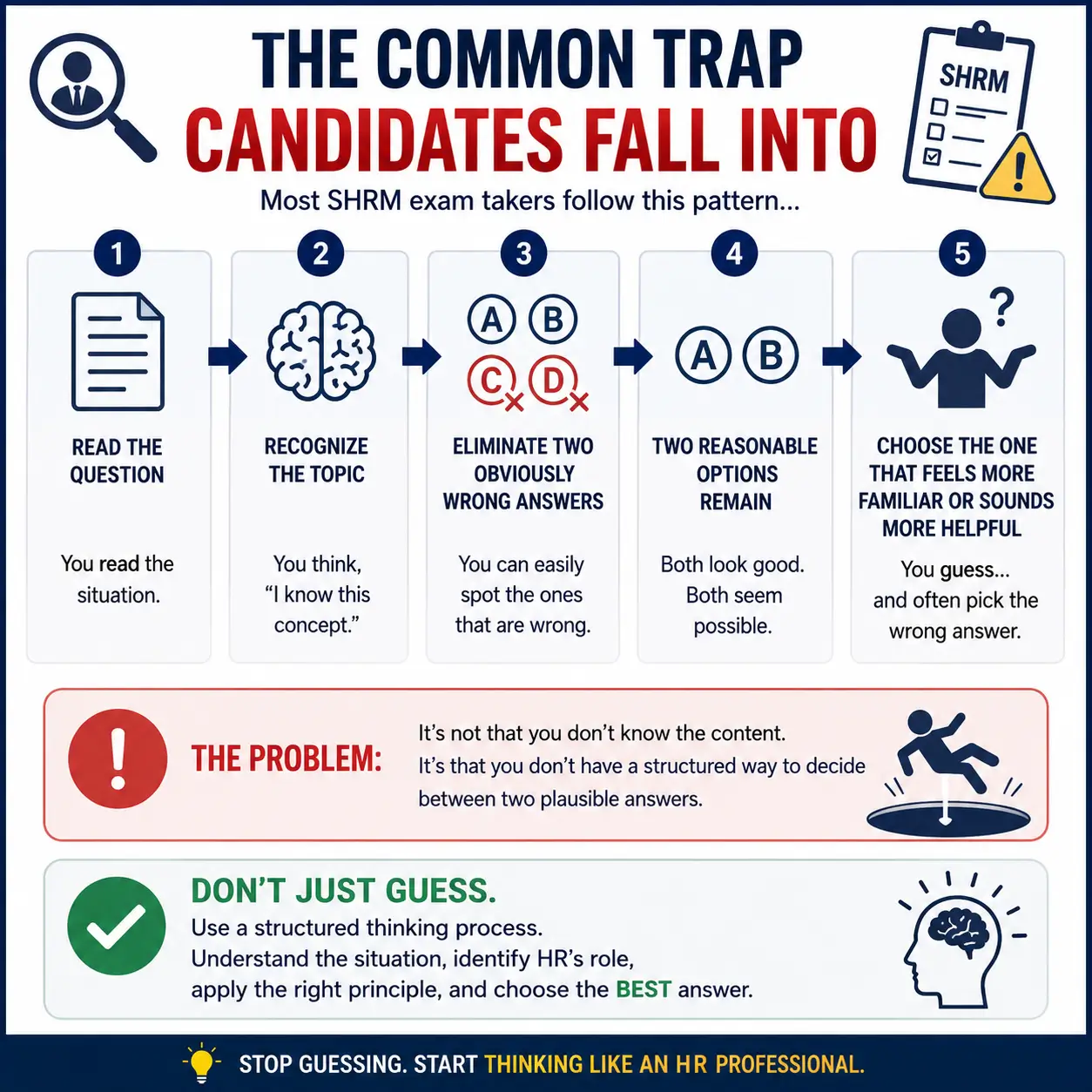
Read the Last Sentence FIRST: The last sentence usually tells you what the question is actually asking (e.g., "What should the HR director do FIRST?" or "What is the BEST way to address this?"). This gives you focus before you get bogged down in the details.
Read the Entire Scenario: Now, read the full prompt with the question in mind. Underline or mentally note the key facts (who, what, where, why).
Generate Your Own Answer: Before looking at the options, based on the SHRM Mindset, what would you do? This prevents you from being led astray by tricky distractors.
Eliminate answers that are clearly illegal, unethical, or bad for business.
Eliminate answers that are passive (e.g., "Wait and see," "Ignore it").
Look for the answer that is proactive, collaborative, and strategic.
For "BEST" and "LEAST" questions, compare the remaining options. Which one is the most aligned with SHRM principles? Which one is the least aligned?
You have about 1 minute and 20 seconds per question.
Don't get stuck! If you're agonizing over a question, make your best guess, flag it for review (if the interface allows), and move on. You can come back if you have time. A minute and a half later, you're still on the same question, and now you're behind.
Goal: Finish all 134 questions. An unanswered question is automatically wrong.
Whiteboard/Scrap Paper: Dump your mnemonics, formulas, and key acronyms as soon as the exam starts. Use it to diagram complex scenarios.
Part 3: Final Words of Encouragement
To the HR Professional about to take the SHRM-CP:
This exam is a significant milestone, and the very fact that you're here, feeling this nervousness, is proof that you care deeply about your profession and your growth.
Remember what you already know. This isn't just about the textbook. It's about the countless conversations you've had with employees, the sticky situations you've helped navigate, the policies you've helped implement, and the business acumen you've developed. You have a wealth of practical knowledge that a book can never teach. The SHRM-CP is designed to test that very judgment.
The exam is a challenge, but it's a fair one. It's designed for professionals like you. Trust your preparation. Trust your instincts. And trust the SHRM Mindset you've worked so hard to develop.
When you sit down to take the exam, take a deep breath. You belong here. You are ready.
You've got this. Now go and show them what an SHRM-CP looks like.




Leave a comment