
SHRM Exam Prep - The Common Trap Candidates Fall Into
Sun, 09 Aug 2026
Follow the stories of academics and their research expeditions
Many candidates assume this means they do not know enough HR content. They respond by studying more: reading another book, watching another video, memorizing more definitions, or completing hundreds of additional practice questions.
But often, that is not the real problem.
The real problem is that they have not developed a structured decision-making process for choosing between two plausible answers.
The SHRM exam frequently creates exactly this situation. The incorrect answers are often not obviously wrong. Several options may sound professional, helpful, or appropriate. Your task is to determine which option is the most appropriate HR action for the specific situation described.
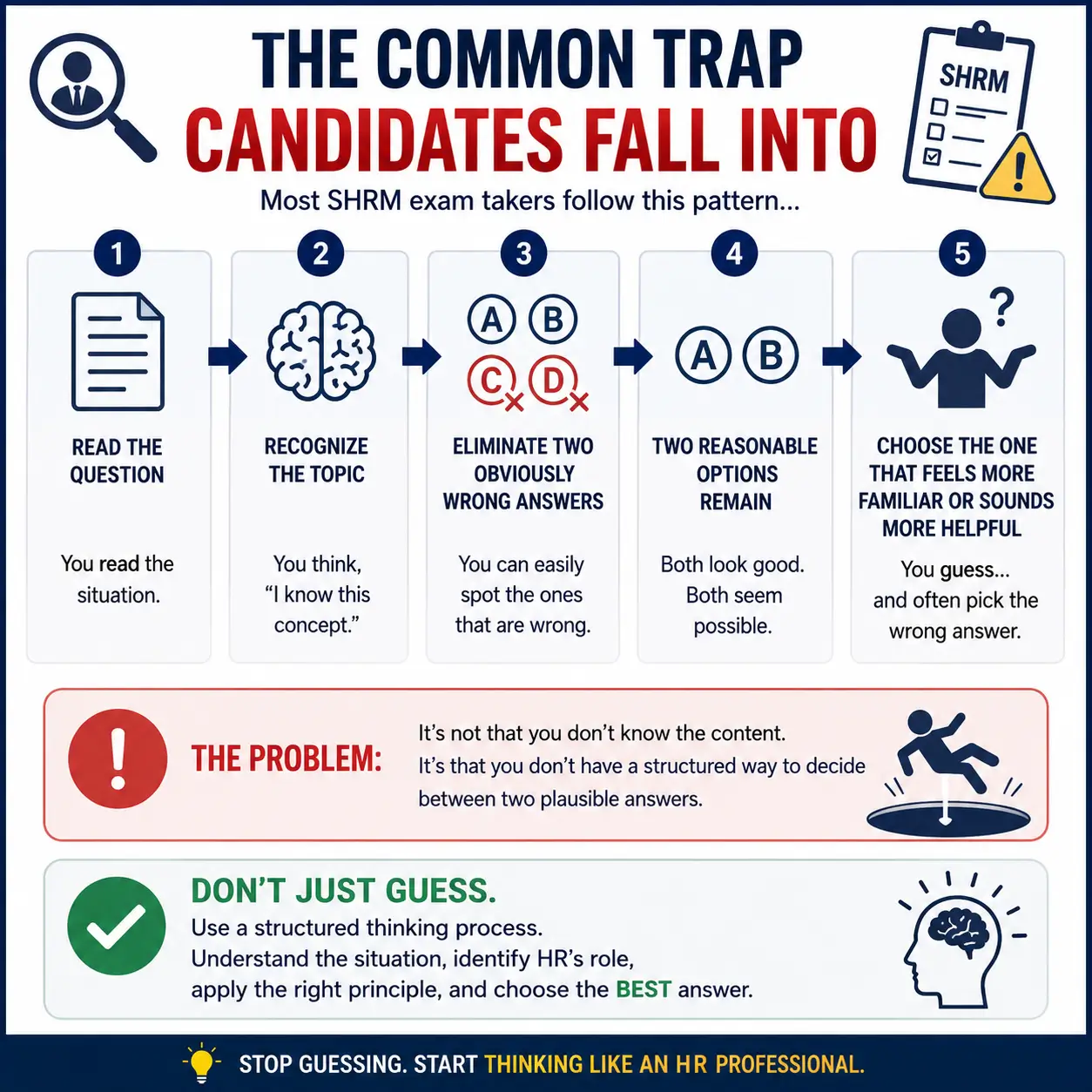
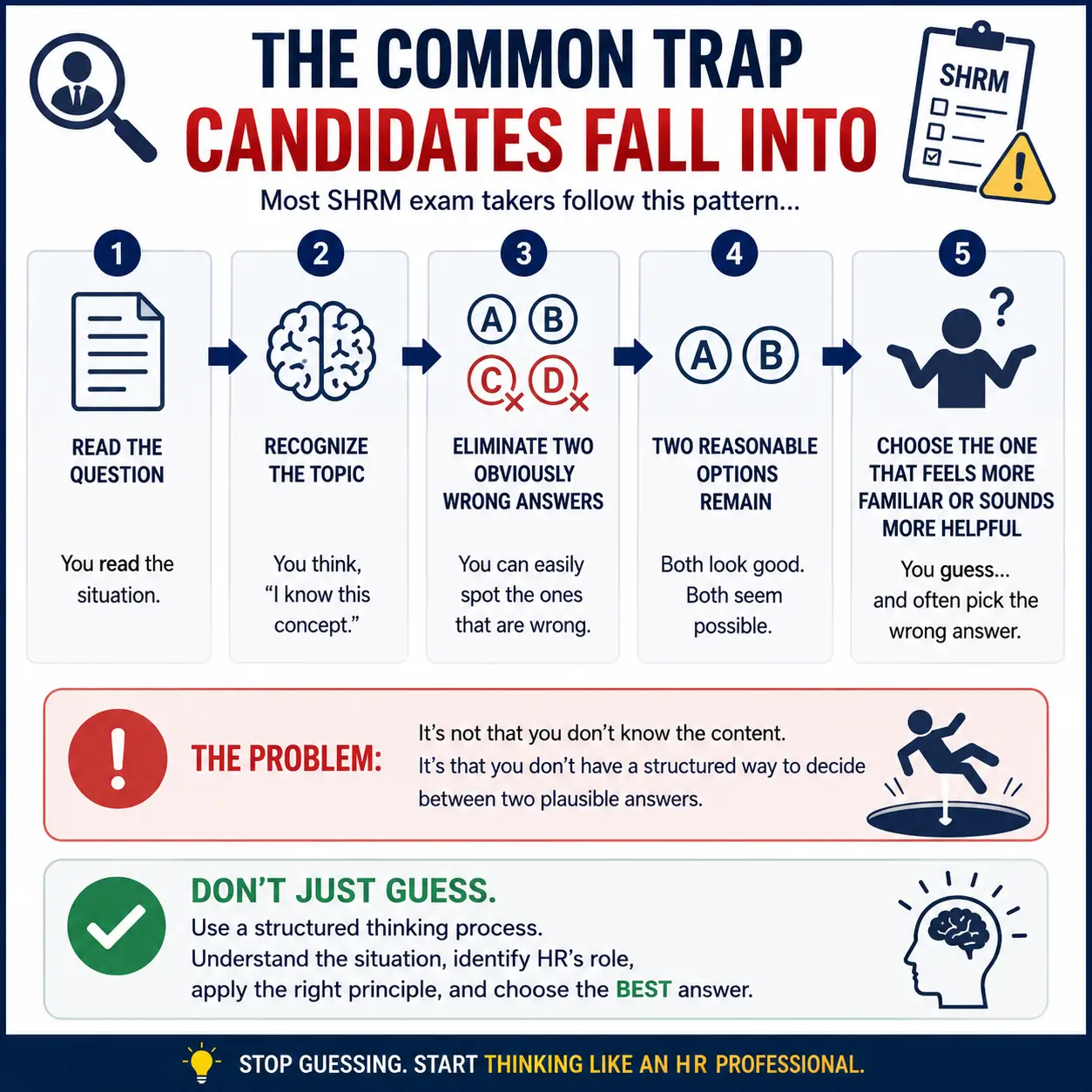
A common SHRM candidate pattern looks like this:
The candidate reads the scenario and tries to understand what is happening.
They may recognize the general HR topic immediately:
Employee engagement
Performance management
Employee relations
Leadership
Compensation
Talent acquisition
Compliance
Organizational development
At this point, the candidate often thinks:
"I know this topic."
That feeling can create a false sense of confidence.
Recognizing the topic is useful, but it does not automatically identify the correct answer.
The candidate connects the question to something they studied.
For example, they may see a question about declining employee performance and immediately think:
"This is an employee engagement problem."
But this is where the trap can begin.
The question may mention that a manager believes employees are disengaged.
That does not necessarily mean disengagement has been confirmed.
The candidate has now made an assumption instead of analyzing the evidence provided in the question.
This is extremely important on the SHRM exam:
Do not automatically accept an assumption presented by a character in the scenario as an established fact.
A manager may have an opinion.
An employee may have a complaint.
A leader may have a theory about the cause of a problem.
HR must determine what is actually known and what still needs to be investigated.
Most candidates are actually good at this part.
They look at four choices and quickly eliminate two.
For example:
A. Take an action that clearly violates company policy.
B. Ignore the issue completely.
C. Gather additional information.
D. Implement a solution immediately.
The obviously inappropriate choices are removed.
Now only C and D remain.
The candidate feels confident because they have successfully narrowed the question down.
But this is where the real SHRM decision begins.
This is often the most difficult part of the exam.
Both answers may sound good.
Both may be things HR could eventually do.
Both may appear professional.
Both may potentially solve the problem.
The candidate now has to determine:
Which answer is the BEST answer for this specific situation, at this specific stage of the problem?
This distinction is critical.
The SHRM exam is not necessarily asking:
"Which answer could work?"
It is asking:
"Which answer is the most appropriate?"
There may be several actions that are technically reasonable.
Only one is usually the best first, next, or most appropriate action based on the facts provided.
When two plausible answers remain, candidates often rely on one of three things.
The candidate chooses the answer that sounds familiar from their study materials.
They think:
"I remember seeing this before, so this must be the answer."
But familiarity does not equal correctness.
Candidates often choose the action that sounds the most positive.
For example:
Improve morale.
Increase engagement.
Provide training.
Communicate with employees.
Reward employees.
Implement a new program.
These actions may sound helpful.
But the question may not yet provide enough evidence to justify taking that action.
A solution can sound beneficial and still be the wrong answer at that moment.
Sometimes candidates simply choose the answer that feels logical.
This is dangerous.
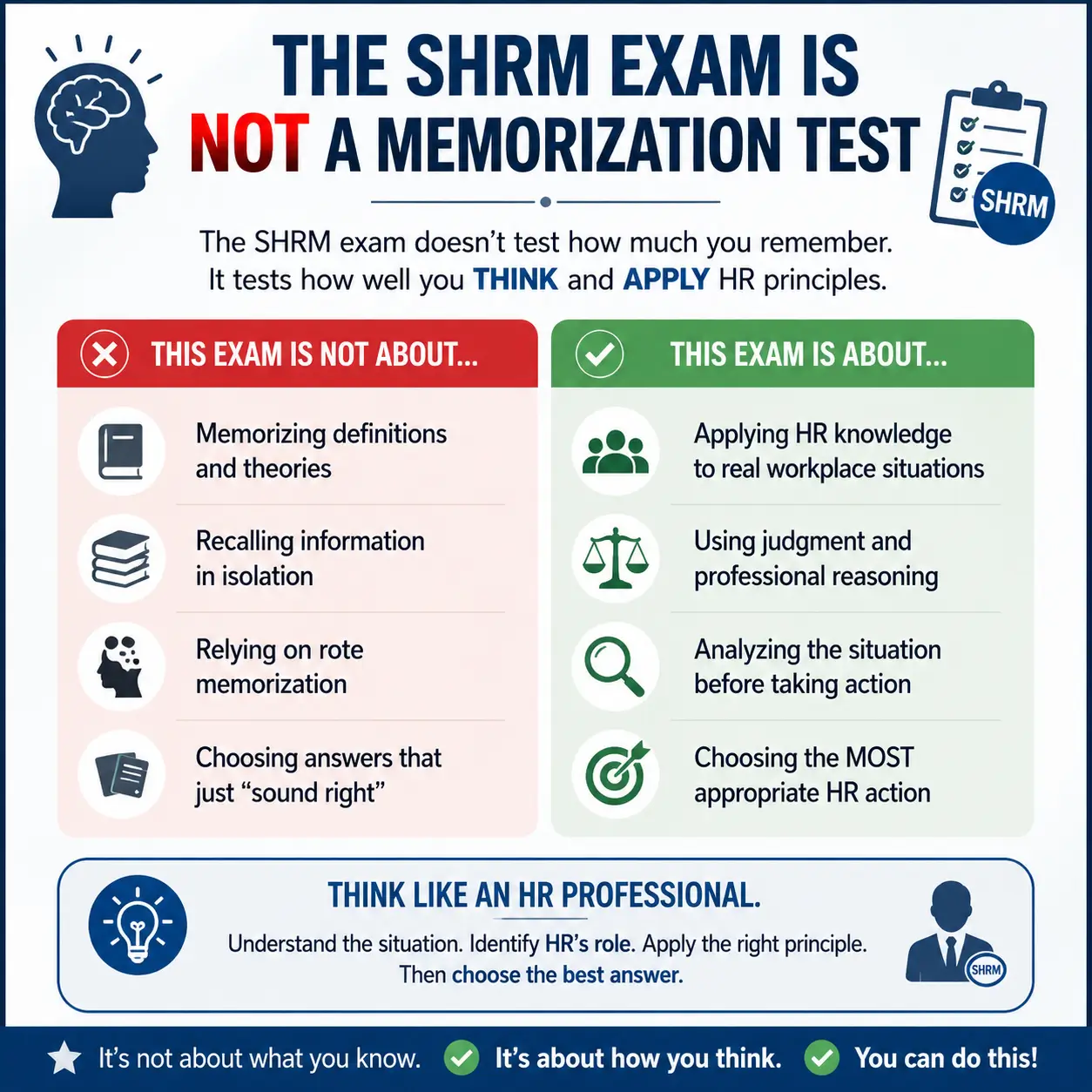
The SHRM exam is designed to test professional judgment, not instinct.
Your personal opinion about what "sounds right" should not determine the answer.
Instead, your decision should be anchored to the facts and principles contained in the scenario.
The common trap is therefore not simply:
"I don't know the answer."
It is often:
"I know enough to eliminate two answers, but I don't have a reliable method for choosing between the remaining two."
This is a completely different problem.
You may understand:
The HR terminology.
The underlying topic.
The general principle.
The meaning of every answer choice.
Yet you can still select the wrong answer because you lack a structured way to compare the options.
One of the most important changes you can make during SHRM preparation is to stop asking:
"Which answer sounds better?"
Instead, ask:
"Why is this answer better than the other reasonable option?"
That small change forces you to think differently.
For example:
"Improving morale sounds helpful."
"Improving morale is premature because the question has not established that low morale is the cause of the performance problem."
The second explanation demonstrates actual HR reasoning.
A powerful SHRM exam rule is:
Consider this example:
"A manager believes employees are disengaged because team performance has declined."
What do we actually know?
Team performance has declined.
Employees are disengaged.
That distinction can completely change the correct answer.
If disengagement has not been confirmed, HR should generally avoid immediately implementing an engagement intervention.
Instead, HR may need to:
Gather information.
Investigate the situation.
Identify the underlying cause.
Analyze relevant data.
Speak with appropriate stakeholders.
The lesson is simple:
Do not solve a problem before you have established what the problem actually is.
When two answers are both reasonable, compare them using several questions.
Identify the actual issue described in the scenario.
Do not add information that the question does not provide.
Separate confirmed facts from opinions, assumptions, and interpretations.
Ask what information is missing.
This is particularly important when the question involves a suspected cause.
Determine what HR should be doing at this stage.
Is HR expected to:
Investigate?
Advise?
Consult?
Analyze?
Facilitate?
Implement?
Measure?
Coach?
Determine whether the organization is:
Identifying → Investigating → Diagnosing → Planning → Implementing → Evaluating
Choosing an implementation action when the organization is still investigating the problem is often a warning sign.
Do not automatically choose the answer that treats the visible symptom.
Ask whether the option helps identify or address the underlying cause.
This is the most important question.
If you cannot explain why your answer is better than the other plausible answer, your reasoning is probably incomplete.
Consider this scenario:
A manager approaches HR because team productivity has declined. The manager believes employees are disengaged.
Two possible answers are:
A. Improve employee morale through an engagement initiative.
B. Gather information to determine the cause of the performance decline.
A candidate who relies on intuition might choose A.
Why?
Because improving morale sounds positive and proactive.
But a stronger HR analysis asks:
Has disengagement actually been confirmed?
No.
The only confirmed information is that productivity has declined.
Therefore, B is stronger because it allows HR to determine what is actually causing the problem before selecting an intervention.
Possible causes could include:
Inadequate training
Poor management
Increased workload
Staffing shortages
Inefficient processes
Lack of resources
Compensation concerns
Employee disengagement
The key is that HR should not assume the cause.
One of the biggest psychological traps in multiple-choice exams is recognition without understanding.
You may remember reading about a particular HR practice.
When you see a similar answer choice, your brain recognizes it and thinks:
"I know this."
But the question is not asking whether the practice is valid.
It is asking whether the practice is the best response to this particular situation.
A correct HR practice can still be the wrong answer if:
It is premature.
It addresses the wrong problem.
It occurs at the wrong stage.
It does not match HR's role.
It ignores important information.
Another answer is more appropriate.
Candidates sometimes believe that the strongest HR answer is the one that takes immediate action.
For example:
Launch a training program.
Conduct an engagement survey.
Change the compensation system.
Discipline the employee.
Implement a new policy.
Start a coaching program.
But effective HR practice is not simply about doing something quickly.
Sometimes the best HR action is:
Pause. Investigate. Gather evidence. Understand the situation.
This is particularly important when the problem has not been clearly diagnosed.
A professional HR approach should be evidence-based rather than assumption-based.
When you reach two reasonable answers, use this process:
What is actually happening?
What do you know for certain?
What does someone in the scenario merely believe?
What information do you need before making a decision?
What should HR be doing?
Are you diagnosing the problem or implementing a solution?
Ask:
"Which option is more appropriate given the information available right now?"
Finish with:
"This answer is correct because..."
If you can clearly explain your reasoning, you are no longer guessing.
You are applying a decision-making framework.
Many candidates focus on becoming faster at eliminating wrong choices.
That is useful, but it is not enough.
The real skill is learning how to distinguish between:
Wrong vs. Right
and, more importantly:
Reasonable vs. BEST.
The SHRM exam often lives in that second distinction.
Instead of simply asking:
"Is this answer correct?"
Ask:
"Why would I choose this answer instead of the other one?"
This creates a much deeper learning process.
For example:
"Implement an employee engagement program."
Potential problem:
The question has not confirmed disengagement.
"Gather additional information."
Advantage:
This allows HR to determine the actual cause before recommending an intervention.
Now the difference becomes clear.
You are no longer choosing based on what sounds helpful.
You are choosing based on sequence, evidence, and HR judgment.
When you are stuck between two good answers, remember:
Don't choose the answer that sounds the most helpful. Choose the answer that is most appropriate for the situation and the stage of the problem.
This single principle can prevent many SHRM exam mistakes.
The common SHRM exam trap is not necessarily a lack of knowledge.
It is the inability to make a structured decision when two answers appear reasonable.
You may know the HR concepts.
You may understand the terminology.
You may be able to eliminate two wrong answers.
But if you choose between the final two based on familiarity, instinct, or what simply sounds helpful, you are still guessing.
Instead, train yourself to:
Understand the situation → Separate facts from assumptions → Identify HR's role → Determine the stage of the problem → Identify the principle being tested → Compare the final answers → Choose the MOST appropriate action.
And always ask yourself:
"Why is my answer better than the other reasonable answer?"
That is the difference between simply knowing HR information and thinking like an HR professional on the SHRM exam.
Sun, 09 Aug 2026
Sat, 04 Jul 2026
Tue, 05 May 2026


Empower your exam success with our all-in-one learning platform. From in-depth courses to practical e-books, everything you need is here with lifetime access, 24/7 support, and unbeatable prices
Leave a comment